Why I'm Staying on Android, Even If the iPhone Sometimes Tempts Me
Price, closed ecosystem, development constraints, and the reality of the Haitian market: my reasons for staying on Android. With one confession: whenever I see an iPhone camera, I crack every time.
 Bendy SERVILUS3 min read5 views
I'm often asked: "You're a developer, why don't you have an iPhone?" As if Apple's phone were a mandatory rite of passage for every tech professional.
I'll be honest right away: I have nothing against the iPhone. It receives updates for many years, it's well-built, and it takes privacy seriously. And there's one area where it tempts me every time. We'll get back to that.
But for my daily use and my work, Android wins. Here is why.
1. The price, compared to what it offers me
A recent iPhone is very expensive, especially in Haiti, where import duties must be added. For the same budget, you can find Android phones with more storage, a larger battery, and a comparable display quality.
For what I use it for on a daily basis, the price gap isn't justified.
2. An ecosystem designed to keep you inside
The iPhone performs best when everything else is also made by Apple: Mac, iPad, AirPods, watch. Outside of this universe, friction quickly appears.
Sending a file to an Android-using colleague, plugging the phone into a Linux computer, managing files freely: everything is possible, but nothing is as simple as on Android. I work with various tools, and I need a phone that adapts to them.
3. The developer pays to publish
This is the reason that matters most to me. To publish an app on the App Store, you need:
An Apple Developer subscription costing $99 per year, to be renewed as long as the app remains online.
A Mac and Xcode for most compilation and testing steps.
Passing Apple's review process, which can reject or delay an update.
On the Android side, registering for the Google Play Console costs $25, just once. You can also distribute an app directly as an APK file.
Tools like Expo now make it possible to compile an iOS app in the cloud, without owning a Mac. That's real progress, but the annual cost and Apple's control remain.
4. The reality of the Haitian market
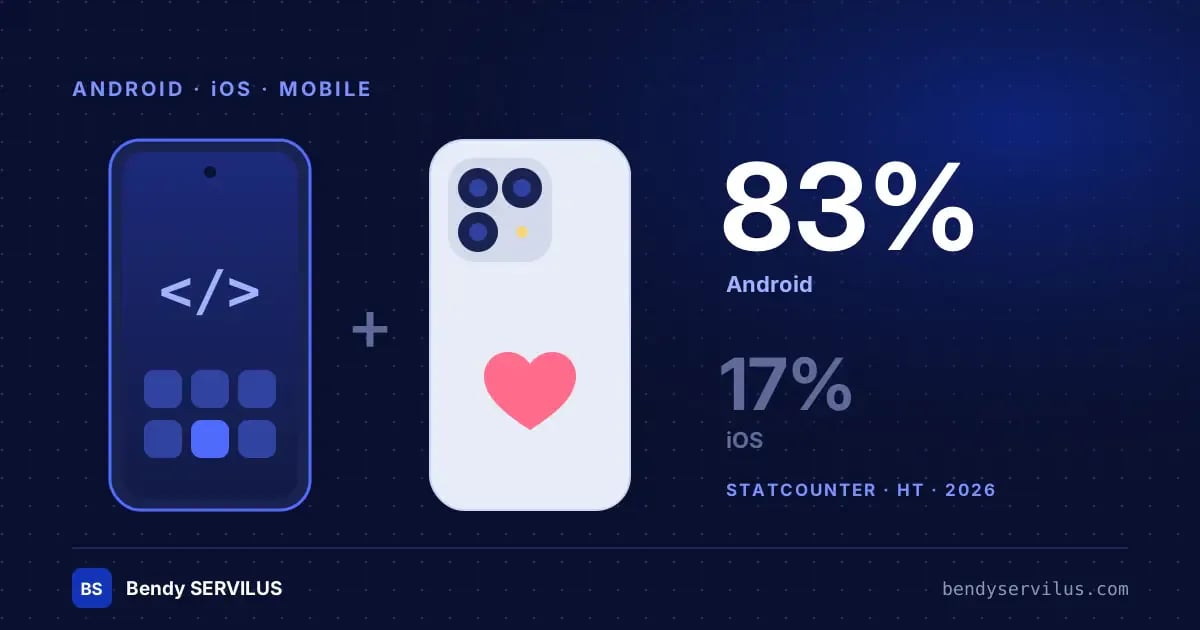
According to Statcounter, in September 2026, Android accounted for 83% of mobile devices in Haiti, compared to 17% for iOS.
When I design an application for SMEs, associations, or mobile money users, I need to test on the phones my users actually hold in their hands. And those are, overwhelmingly, Androids. Using them daily means experiencing the exact same thing as the people I'm building for.
5. My weak spot: photography
Now, the confession. Every time someone takes a picture of me with an iPhone, I fall in love with it. The colors are natural, skin tones are rendered well, portrait mode is clean, and the photo is ready to publish without editing.
Good Androids also take great pictures. But the iPhone has that consistent, flattering look that makes you want to say: "Send me that one!"
So yes, I sometimes tell myself the ideal solution would be to have both: an Android for work, an iPhone for photos. 😄
It's not a war
The iPhone isn't a bad choice, and for many people, it's the best one. Simply put, for what I build and for the people I build it for, Android remains my main tool.
Choosing your phone is like choosing a programming language: there is no absolute best tool, only the one best suited to what you are doing. And sometimes, the best choice is to have two.
Sources and references
Share this note
Comments
No comments yet. Be the first to share your thoughts.